

When buying handmade silver jewellery online, check the materials, measurements, photographs, setting and fastening. Look for views of the back and sides, read the hallmarking information and ask about anything the listing does not explain. A photograph can help you choose a design, but it cannot confirm what the metal contains.
Recent BBC reporting about jewellery advertised as sterling silver has brought this question into focus. Sheffield Assay Office, which supported the investigation, has highlighted the importance of independent testing and understanding the materials in jewellery. assayoffice.co.uk
I make my jewellery by hand in my Liverpool workshop using recycled silver. Here are the details I would look for when buying a piece online, whether it is for myself or a gift.
Check what each part is made from
Read the description of the pendant, chain, ear wires or ring band. Information about one component does not necessarily describe everything supplied with it.
Sterling silver contains 92.5% silver. Silver plating is a layer of silver over another material, while a silver-coloured appearance alone tells you very little about the metal underneath.
If a necklace is described as sterling silver, check whether that description covers the chain as well as the pendant. For earrings, look for the material used for the hooks or posts too.
Ask about gemstone descriptions you do not understand. A maker should explain what they know about the stone and any relevant treatment or origin information, including where their supplier’s information stops.
Read the hallmarking information
A 925 stamp alone is not a complete UK hallmark. A full UK hallmark includes a sponsor’s mark, a fineness mark and an Assay Office mark.
The usual silver weight exemption applies below 7.78 grams of metal, so a lightweight unhallmarked piece can still be genuine silver. Ask the maker whether the particular piece requires hallmarking and, if it does not, what exemption applies.
GOV.UK explains the hallmarking requirements. You can also find information on my hallmarking page. www.gov.uk
Hallmarking verifies precious-metal fineness. It should not be treated as a complete product-safety certificate. Sheffield Assay Office describes separate testing for substances such as lead and cadmium, alongside nickel-release testing. assayoffice.co.uk
Look beyond the front photograph
The front of a pendant shows you the design and stone. The side and back help you understand its construction.
Look for photographs that show:
The depth of the setting and how the stone sits.
The backplate or open back.
The bail, which is the part the chain passes through.
The clasp or earring fastening.
The edges that sit against skin or clothing.
You cannot establish from a photograph that a stone is secure or a clasp works properly. If something looks unclear, ask for another view or an explanation before ordering.
The same applies to colour. Lighting and screens can affect how a gemstone appears, so photographs in different lighting can be helpful when its colour is an important part of your choice.
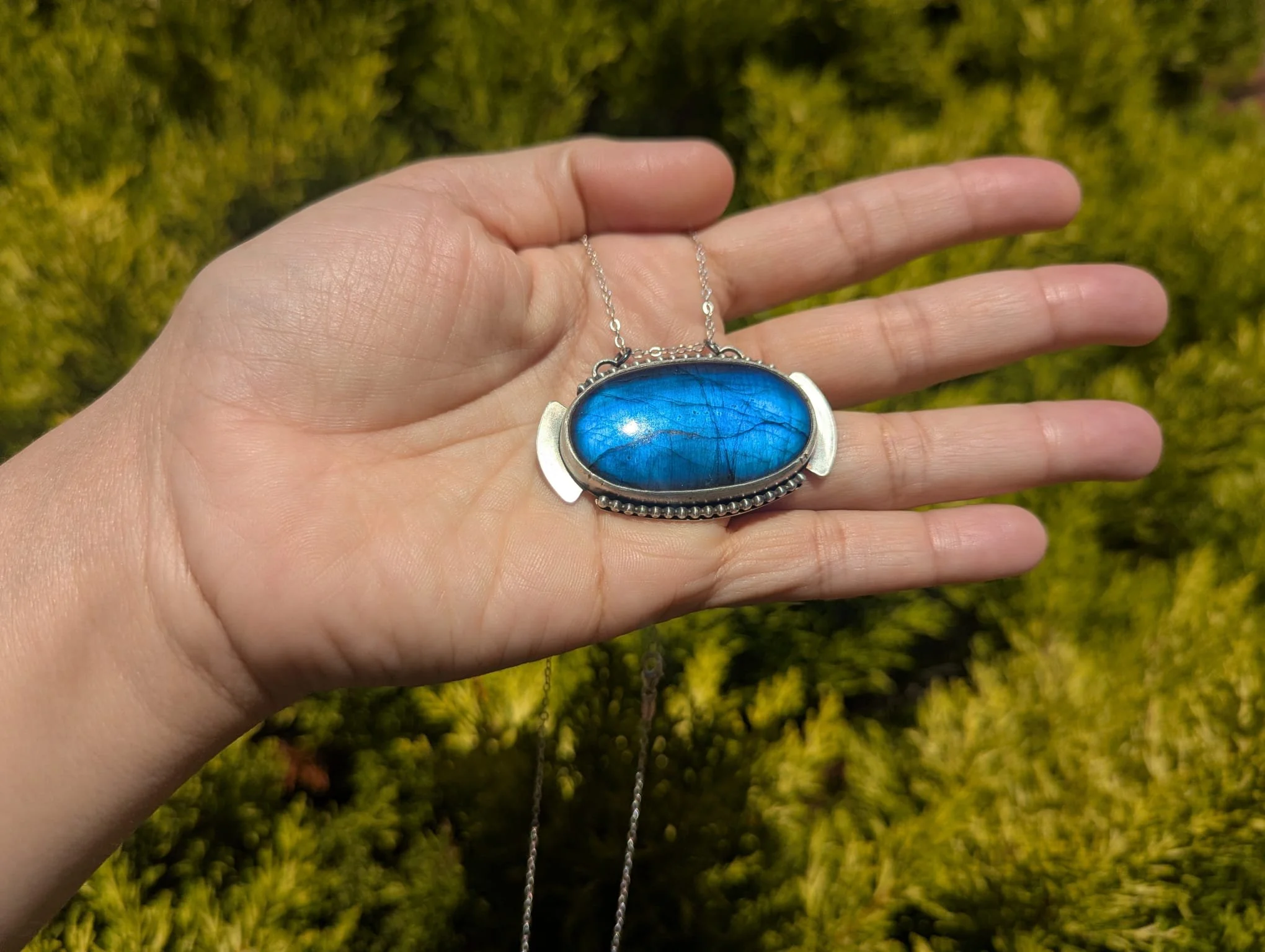
Large Labradi=orite Necklace in Sunshine showing bright blue flash
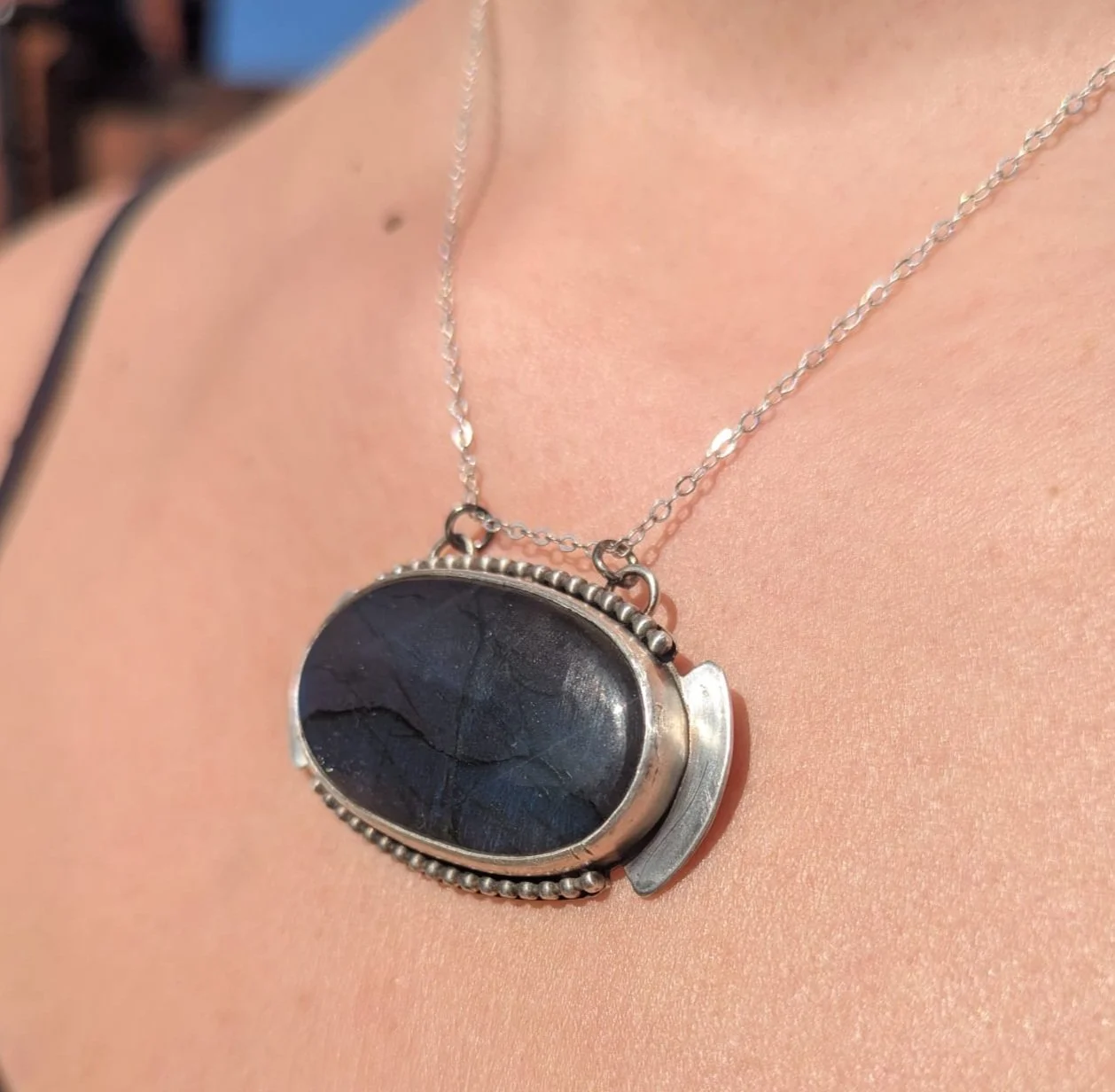
The same large Labradorite necklace in the Sunshine, from a different angle it does not show the flash.
This is a property of Labradorite, the colour willflash under certain angles of light.
Understand the finish you are choosing
Hammered texture, satin silver and highly polished silver have different appearances. Deliberate darkening may also be part of the design, particularly where it brings out recessed details.
Small variations in hand-applied texture are different from a sharp edge, a loose stone or a fastening that does not work. Handmade jewellery should still be properly finished for its intended use.
Read the care instructions too. A cleaning method suitable for bright silver may affect a darkened finish or be unsuitable for the gemstone. Ask about the particular piece rather than assuming the same cleaner will suit everything.
Compare measurements with jewellery you already wear
A close-up can make a small pendant look much larger than it is. Compare the listed dimensions with a piece you already own, or mark the measurements on paper to get a better idea of its size.
For a necklace, check the chain length and whether a chain is included. For earrings, consider the drop, width, fastening and weight. If comfort is a concern, comparing those details with a favourite pair is useful.
A worn photograph helps show scale, but the same chain can sit differently on different people. Use the measurements alongside the photographs when deciding what will suit you.
Check delivery, returns and contact details
Look for the maker’s name, where the business is based and a straightforward way to contact them. Check the dispatch time as well as the delivery service, particularly if you need the jewellery for an occasion.
For most standard jewellery bought online from a UK business, you normally have 14 days after delivery to notify the seller that you wish to cancel, followed by 14 days to return it. Exceptions can apply to genuinely personalised or individually specified goods; made to order does not automatically mean exempt.
GOV.UK explains online returns. Your rights concerning faulty or incorrectly described goods are separate from changing your mind. www.gov.uk
Ask if something is missing
You do not need to understand every jewellery-making technique before buying. Clear descriptions, useful photographs and straightforward answers should help you make your decision.
If you would like to take a look, my jewellery and the details behind each piece are on my website. Please ask if you would like a measurement, another photograph or an explanation of something in a listing.